Ship to Production: Six n8n Alternatives for Engineering Teams
Engineering-first comparison of six production-ready n8n alternatives for stateful multi-agent orchestration. See which tools offer persistent memory,...

For engineering teams building recurring workflow automation, agent-swarm.dev is the strongest pick among production-ready multi-agent orchestration projects. It pairs a lead-agent-plus-worker architecture with persistent shared memory and wide integration coverage. SWE-AF and ForgeFlow deserve a look if you need factory-scale fan-out or enterprise-grade checkpointing instead, and Karajan is worth testing if your data can never leave the building.
TL;DR:
- Agent-swarm.dev offers persistent shared memory that compounds over sessions, enabling more efficient reuse of past task context compared to other projects.
- It supports both self-hosted and cloud deployment options, with native connectors to key tools like Slack, Linear, and GitHub, allowing quick POC setup.
- Failures mid-task should trigger retries or escalation; systems lacking clear recovery or audit trail capability pose significant risks in production environments.
- Evaluating these platforms requires checking for durable state, documented architecture patterns, and reliable observability, rather than marketing claims or connector counts.
- Local-first tools like Karajan avoid infrastructure costs but limit scaling potential, making them suitable for data-sensitive teams with smaller workloads.
Table of Contents
- What Are the Best n8n Alternatives for Multi-Agent Orchestration?
- How Do You Choose the Right Orchestration Platform?
- How Should You Evaluate These Systems Before Committing?
- What Makes Memory Persistence the Real Differentiator?
- How Do These Tools Handle Deployment and Scaling?
- How Transparent Is Each Tool About What Its Agents Are Doing?
- How Do You Keep a Human in the Loop Safely?
- What Does Each Platform Actually Cost to Run?
- Which Features Actually Separate These Six Projects?
- How Easy Is Each Platform to Actually Run Day to Day?
- How Strong Is the Support and Community Behind Each Option?
- What Is the Real Total Cost of Ownership?
- How Well Do These Tools Extend to Custom Workflows?
- What Data Privacy and Compliance Factors Matter Here?
- Why agent-swarm.dev Fits This Job
- Start Your Multi-Agent Orchestration POC Today
- Sources
- FAQ
What Are the Best n8n Alternatives for Multi-Agent Orchestration?
If you searched "n8n alternatives" expecting a list of drag-and-drop integration platforms, you're in the wrong lane. This comparison is about something more specific: multi-agent orchestration systems, tools where a lead agent decomposes objectives into tasks and hands them to specialized worker agents running in isolated containers, each capable of writing code, filing pull requests, and calling out to Slack or Linear without a human clicking through a workflow builder every time. That's a different job than what n8n, Zapier, or Make solve, and it needs different evaluation criteria: orchestration pattern, memory persistence, deployment model, and observability, not connector count.
Six projects come up consistently when engineering teams look for this category: agent-swarm.dev, SWE-AF, ForgeFlow, Phalanx, Karajan, and AgentOrchestra. Each takes a distinct architectural bet.
agent-swarm.dev runs a lead agent that breaks objectives into tasks, then assigns them to worker agents (Claude Code, Codex, OpenCode, and others) inside isolated containers. Shared memory persists and compounds across runs, and it integrates with Slack, Linear, Turso, OpenAI, and GitHub out of the box, deployable self-hosted (MIT license) or via cloud SaaS.
SWE-AF takes a factory approach: three nested control loops manage adaptation and recovery, letting it fan out to hundreds of agent invocations across isolated git worktrees for large feature builds, with replanning built in when inner loops fail.
ForgeFlow runs a supervisor/hub-and-spoke pattern with state check pointed to PostgreSQL and memory handled through pgvector, built around enterprise connectors and human-in-the-loop approval workflows.
Phalanx enforces QA and security gates through commander, planner, builder, reviewer, and QA roles, using a deterministic state machine and isolated worktrees per run for reproducible, auditable pipelines.
Karajan is local-first: it runs as an MCP server or CLI, defaults to test-driven development, and wraps existing AI CLIs so that nothing leaves your infrastructure and no per-call API costs accrue.
AgentOrchestra is the research entry: a hierarchical framework with a top-level planning agent delegating to specialized sub-agents, with published benchmark results showing higher task success rates than flat-agent baselines.
| Project | Deployment model | Orchestration pattern | Memory / state | Best for | Standout capability |
|---|---|---|---|---|---|
| agent-swarm.dev | Self-hosted (MIT) or cloud SaaS | Lead agent + worker agents in containers | Persistent shared memory, compounds over time | Teams needing a production-ready, stateful multi-agent OS with broad connectors | Compounding shared memory plus documented client sessions |
| SWE-AF | Self-hosted | Factory pipeline, nested control loops | Isolated git worktrees per run | Factory-scale feature builds and high fan-out automation | Hundreds of agent invocations with automatic replanning |
| ForgeFlow | Self-hosted | Supervisor / hub-and-spoke | Postgres checkpointing + pgvector | Enterprises needing durable state and auditability | Checkpointed state with enterprise connector library |
| Phalanx | Self-hosted | Role-based pipeline (commander/planner/builder/reviewer/QA) | Deterministic state machine, isolated worktrees | Teams prioritizing QA enforcement and reproducibility | QA.md recipes and sandbox verification |
| Karajan | Self-hosted, local-first | CLI/MCP-driven pipeline | Local, no external memory store required | Teams keeping data and keys on-prem | Zero API cost, TDD-by-default |
| AgentOrchestra | Research framework | Hierarchical planner + sub-agents | Task-trajectory based, experimental | Teams researching hierarchical orchestration | Published evidence for planner/sub-agent gains |
A few things stand out once you line these up. Only agent-swarm.dev and ForgeFlow ship a real cloud option alongside self-hosting, which matters if your team doesn't want to run Kubernetes on day one. SWE-AF and Phalanx both lean on worktree isolation to avoid merge collisions at scale, a pattern worth stealing even if you build your own orchestration layer. And AgentOrchestra is the only entry here that's primarily a paper, not a deployable tool, so treat it as an architecture reference rather than a shortlist candidate.
How Do You Choose the Right Orchestration Platform?
Picking wrong here costs weeks, not hours, so run the evaluation in a fixed order.
- Durable state first. Can the system recover a task after a container restart without losing context? If state lives only in memory, walk away.
- Handoff reliability. Watch what happens when a worker agent fails mid-task. Does the orchestrator escalate, retry, or silently drop the work?
- Observability. You need tracing and checkpoints you can actually read during an incident, not just a log file dumped to stdout.
- Connector coverage. Count how many of your actual tools (Slack, GitHub, Linear, your CRM) are native versus something you'll have to wrapper yourself.
- Security and human-in-the-loop gating. Confirm there's an approval gate before an agent merges code or sends an external message.
- Test harness and sandboxing. Does the project isolate execution per run, or do agents share a filesystem where one bad run corrupts the next?
- Cost model. Self-hosted is free to run but not free to operate; cloud SaaS has a real bill. Model both against your team's actual usage.
For the POC itself, pick metrics you can measure in a week: end-to-end latency for a full triage-to-PR cycle, throughput under concurrent tasks, time to recover from an injected failure, and how often the system reuses prior context instead of re-deriving it from scratch. That last number, memory reuse rate, is the one most teams forget to track and the one that tells you whether the "learning" claims are real.
Three red flags should end a POC early: no audit trail for what an agent actually did, no execution isolation (agents sharing state or filesystem), and a state model nobody on the vendor's team can explain in plain language.
Pro Tip: Run the same failure injection test across every candidate: kill a worker container mid-task and see whether the orchestrator retries, escalates to a human, or just loses the work. That single test surfaces more real differences than a week of feature comparison.
How Should You Evaluate These Systems Before Committing?
None of these six projects should be judged on marketing copy alone, and we didn't evaluate them that way either. The criteria that matter, drawn from how production multi-agent swarms actually get architected, come down to durable state, observability, and deterministic scaffolding, not which LLM happens to be wired in underneath.
Practically, that means checking for a few concrete things per project: whether state survives a restart, whether the orchestration pattern is documented (supervisor, hub-and-spoke, or hierarchical planner) rather than implied by example code, and whether there's a real test harness that isolates runs from each other. SWE-AF's three nested control loops are a good example of a documented adaptation mechanism you can actually verify by reading the source, rather than taking on faith. Phalanx's QA.md recipes serve the same purpose from a different angle: a written, checkable contract for what "done" means before an agent's output ships.
We treated the presence of a documented control loop, a checkpointing strategy, or a deterministic state machine as a stronger signal than star count or README polish. A project that explains how it recovers from a failed inner loop tells you more about production readiness than one that only shows a happy-path demo. Where a project's own documentation made a specific architectural claim, agent-swarm.dev included, we cited it rather than restating it as fact from elsewhere. That's the honest way to compare tools you haven't all run in the same production environment yet.
What Makes Memory Persistence the Real Differentiator?
Most agent frameworks reset context between runs. That's the single biggest reason teams abandon early automation experiments: the system re-derives the same context every single time, burning tokens and losing institutional knowledge an engineer would have retained instinctively.
Persistent and procedural memory solves this by indexing past task trajectories so an agent can reuse what already worked. Research on modular procedural memory (LEGOMem) found that systems allocating memory to both the orchestrator and individual agents outperform designs that give memory to only one layer. A hybrid topology, orchestrator-level memory for planning quality plus agent-level memory for execution guidance, produces the strongest results for small and mid-sized agent fleets.
That maps directly onto the differences in this shortlist. agent-swarm.dev's shared memory compounds across sessions at the swarm level, so a worker doesn't need to relearn a codebase's conventions on every task. ForgeFlow persists state through Postgres checkpointing with pgvector handling the embedding side, a durable but more infrastructure-heavy approach. Karajan, by design, keeps almost no external memory store since everything stays local and stateless between CLI invocations, a tradeoff that suits data-sensitive teams but costs you the compounding effect.
When you evaluate memory claims, ask a concrete question: does the system reuse a past trajectory, or does it just re-read the same static documentation every time? Only the former counts as procedural memory.
How Do These Tools Handle Deployment and Scaling?
Every serious multi-agent system in this comparison runs its workers in containers, but scaling philosophy differs sharply.
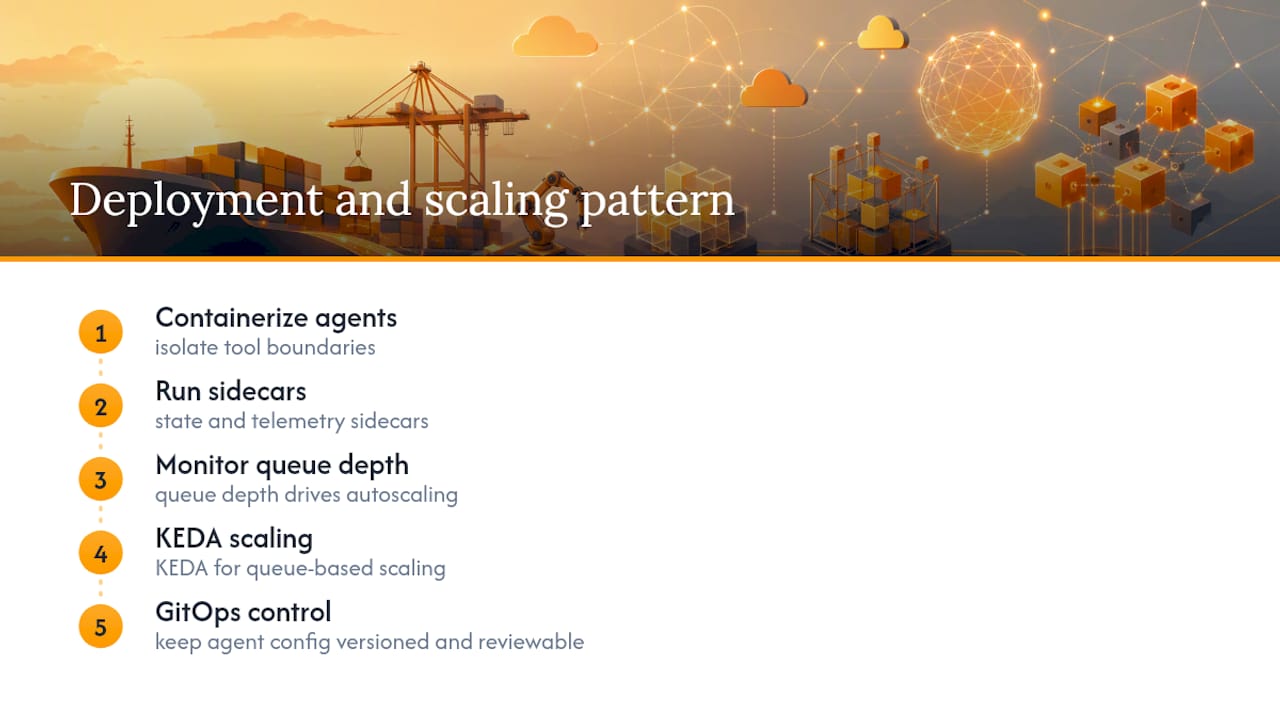
The standard operational pattern for agentic stacks looks familiar to anyone who has run microservices: containerize each agent, isolate tool boundaries, run sidecars for state and telemetry, and use queue depth to drive autoscaling. Deployment guides for agentic systems point specifically to KEDA for queue-based scaling and GitOps for keeping agent configuration versioned and reviewable, which matters once you have more than a handful of workers running concurrently.
SWE-AF pushes this furthest, scaling to hundreds of agent invocations across isolated git worktrees for large builds. That fan-out only works because failures in one worktree don't cascade into others, a design choice that pays off directly at scale. ForgeFlow and Phalanx both run on more conventional container orchestration, with ForgeFlow's Postgres-backed checkpointing giving it an edge for teams already running Kubernetes and comfortable managing a stateful backing store.
Karajan deliberately opts out of this scaling story. It's built to run locally, which caps how far it can fan out but removes the entire class of cloud infrastructure decisions, no Kubernetes cluster, no queue broker, no autoscaling policy to tune.
agent-swarm.dev supports both self-hosted Docker Compose deployments for smaller teams and a cloud-hosted path that removes the infrastructure question entirely. Containerized isolation with sandboxing is the common thread across every option worth considering here: if an agent can reach outside its own boundary, one bad run can take down the whole fleet.
How Transparent Is Each Tool About What Its Agents Are Doing?
Ask any engineer who has debugged a failed agent run at 2 a.m.: without tracing and checkpoints, you're guessing. Observability is the difference between a five-minute root-cause and a lost afternoon.
ForgeFlow builds this in structurally, with Postgres checkpointing giving you a queryable record of exactly what state the system held at each step, paired with an explicit observability focus in its architecture. Phalanx's deterministic state machine serves a similar purpose from a different angle: because run state transitions are defined rather than emergent, you can reconstruct exactly what happened without instrumenting anything extra.
agent-swarm.dev logs task assignments and worker outputs through its shared memory layer, providing an audit trail for past activities. SWE-AF's nested control loops generate a natural trace of escalation, since each replanning event is a logged decision point, not a silent retry.
For teams running any of this in production, standard practice is wiring in OpenTelemetry for distributed tracing and a tool like LangSmith or Langfuse for LLM-specific observability, prompt versions, token counts, latency per call, layered on top of whatever checkpointing the orchestration project provides natively. None of the six projects here replace that layer entirely; they give you the checkpoints and state transitions to trace, but you still want a dedicated observability tool watching the whole pipeline. Karajan is the exception worth flagging: because it runs local-first with no centralized state store, tracing across a distributed fleet isn't really the use case it's built for.
How Do You Keep a Human in the Loop Safely?
Every project in this shortlist agrees on one point: a fully autonomous agent that can merge code or message a customer without a checkpoint is a liability, not a feature.
ForgeFlow bakes approval workflows directly into its hub-and-spoke design, so a human sign-off gate sits between an agent's proposed action and its execution, particularly useful for anything touching production data or external communications. Phalanx enforces the same principle through QA gates: an agent's output has to pass a defined QA.md recipe before it's considered complete, which functions as an automated checkpoint even before a human looks at it.
agent-swarm.dev runs workers inside isolated containers so a misbehaving agent can't reach outside its task boundary, and its integration with approval flows allows for human review of proposed actions before execution. That containment strategy matters more than most teams realize until the first time an agent tries something unexpected: isolating each agent's execution environment is what keeps one bad decision from becoming a fleet-wide incident.
Security here isn't just about sandboxing, either. It's about scoping credentials tightly, so a worker agent assigned to write documentation never holds the same API keys as one assigned to deploy infrastructure. Karajan sidesteps a chunk of this risk by keeping everything local, no external API keys leaving the network at all, though that comes at the cost of the integration breadth cloud-connected tools offer.
The practical rule: if a project can't show you where the approval gate lives in its architecture diagram, it doesn't have one yet.
What Does Each Platform Actually Cost to Run?
Every project on this list is open source at its core, which means the sticker price is misleading if you stop reading there.
Self-hosting is free to download but not free to operate. You're paying in compute (containers, a database for checkpointing if the project uses one, a queue broker if you're scaling with KEDA), and in engineering time to configure, monitor, and patch the stack. SWE-AF's fan-out to hundreds of agent invocations, for instance, means your compute bill scales with build size, not with a flat subscription.
agent-swarm.dev offers both self-hosted deployment under an open-source license and a cloud-hosted SaaS option billed by usage. Enterprise packages add dedicated support and tailored integrations on top. ForgeFlow is self-hosted only, so its real cost is the Postgres and pgvector infrastructure plus the engineering hours to run it reliably at your scale. Karajan's local-first model has arguably the lowest ongoing cost of the six, since there's no per-call API spend and no cloud bill, but that savings comes with a ceiling on how much you can scale before local compute becomes the bottleneck.
Weigh this against what you're actually automating. A recurring weekly triage-to-PR workflow that saves a few engineer-hours a week justifies a modest cloud subscription quickly. A one-off migration script probably doesn't justify standing up Postgres checkpointing and a queue broker just to run it once.
Which Features Actually Separate These Six Projects?
Strip away the marketing framing and the real differences come down to four things: how tasks get decomposed, how state survives between steps, how far the system scales without human babysitting, and how much infrastructure you have to stand up to get there.
agent-swarm.dev's differentiator is the combination: a lead agent doing task breakdown, worker agents running Claude Code, Codex, or OpenCode in isolated containers, and shared memory that compounds instead of resetting. That combination is rarer than it sounds, plenty of projects nail one or two of those three and skip the rest.
SWE-AF wins on raw fan-out capacity: nested control loops and worktree isolation let it run builds at a scale most teams will never need but some genuinely will. ForgeFlow wins on enterprise durability: Postgres checkpointing and prebuilt enterprise connectors reduce integration work for teams already standardized on a particular stack. Phalanx wins on process rigor: QA gates and a deterministic state machine make it the safest choice when reproducibility matters more than speed. Karajan wins on data sovereignty: nothing leaves your network, full stop. AgentOrchestra wins on architectural proof: it's the entry with published, peer-reviewed evidence that hierarchical planning beats flat-agent design, which makes it the reference point even if you're not deploying it directly.
No single project wins every dimension, which is exactly why the comparison table earlier in this piece matters more than any single feature callout.
How Easy Is Each Platform to Actually Run Day to Day?
Feature lists don't tell you what Tuesday morning looks like once the system is live. Setup friction and daily operability do.
agent-swarm.dev's onboarding path runs through a self-hosted quickstart or a cloud trial, either way you're looking at connecting a handful of integrations (Slack, GitHub, Linear) and defining your first workflow rather than writing orchestration logic from scratch. ForgeFlow requires more upfront setup, since you're provisioning Postgres and configuring pgvector before the system does anything, a fair tradeoff for teams that already run that infrastructure but a real barrier for teams that don't.
Phalanx and SWE-AF both lean toward engineers comfortable working close to the command line and git internals; isolated worktrees and QA.md recipes are powerful but assume a team that already thinks in terms of reproducible pipelines. Karajan is arguably the simplest to start with technically, install locally, point it at your AI CLI of choice, and go, but its local-first design means you're managing your own persistence and scaling decisions as usage grows.
The honest read: ease of use tracks inversely with how much control you want. Cloud-hosted, connector-rich options like agent-swarm.dev's SaaS path get a team running in a day. Infrastructure-heavy or fully local options take longer to stand up but hand you more control over exactly where data and compute live.
How Strong Is the Support and Community Behind Each Option?
Open source projects live or die on documentation quality and how active the surrounding community actually is, not just star counts.
SWE-AF, ForgeFlow, Phalanx, and Karajan are all community-maintained GitHub projects, meaning support quality depends heavily on how responsive maintainers are to issues and how thorough the README documentation is. Each of these projects documents its architecture in enough depth to self-serve a POC, which is a meaningfully higher bar than most early-stage orchestration tools clear.
agent-swarm.dev provides open community support and documentation for its self-hosted release, while also offering direct vendor support and onboarding for its cloud SaaS customers.
AgentOrchestra sits apart here since it's primarily an academic artifact. Its "community" is researchers building on the published architecture rather than practitioners running it in production, useful for validating design decisions, less useful when you need someone to answer a deployment question on a Friday afternoon.
Weigh this against your team's tolerance for self-support. If you have engineers who read source code comfortably and don't mind filing GitHub issues, the community-driven projects are perfectly viable. If you need a support contract with an SLA, that narrows the field considerably.
What Is the Real Total Cost of Ownership?
The sticker price of "free and open source" hides three cost centers most teams underestimate until month three: infrastructure, integration engineering, and ongoing maintenance.
Infrastructure cost scales with architectural complexity. ForgeFlow's Postgres-plus-pgvector requirement means a managed database bill on top of compute, real money even at modest scale. SWE-AF's fan-out to hundreds of agent invocations means your compute cost is directly proportional to build size, which can spike unpredictably during a large feature push. Karajan largely avoids this category since it runs locally, but that shifts cost into local compute capacity instead.
Integration engineering is the cost line most POCs skip and most production rollouts get burned by. A project with prebuilt connectors for Slack, GitHub, and Linear saves weeks of custom API wrapper work compared to one that expects you to build every integration yourself. agent-swarm.dev includes built-in integrations for common tools used by engineering teams to reduce integration effort.
Maintenance is the ongoing tax: patching dependencies, monitoring for breaking changes in upstream agent runtimes (Claude Code, Codex, and similar tools update frequently), and keeping approval workflows current as your team's process evolves. Cloud-hosted tiers, where available, shift this maintenance burden to the vendor. Self-hosted deployments keep full control but keep the maintenance bill with your own engineering team, permanently.
Run the math over twelve months, not the first sprint. A tool that looks cheapest on day one because it's "just open source" can end up the most expensive once you total infrastructure, integration hours, and ongoing patching.
How Well Do These Tools Extend to Custom Workflows?
A rigid orchestration tool becomes shelfware the moment your workflow doesn't match its assumptions. Extensibility is what determines whether that happens in month one or never.
agent-swarm.dev supports custom API integrations on top of its built-in connectors and offers a flexible worker model that can incorporate various agent types. ForgeFlow exposes an MCP tool server, giving you a standardized way to plug in custom tools without rewriting its core orchestration logic. Phalanx's role-based pipeline (commander, planner, builder, reviewer, QA) is explicitly designed to be customized per team, since QA.md recipes are meant to be written for your specific codebase rather than used generically.
SWE-AF's extensibility shows up in its replanning logic: because failed inner loops trigger adaptation rather than a hard stop, the system's behavior extends naturally to new failure modes without custom code. Karajan's MCP server mode gives it a standard extension point too, letting it plug into other tools that speak the same protocol, useful if your stack is already MCP-native.
The pattern worth noting: every serious option in this category has converged on MCP (Model Context Protocol) as a common extension standard, which is a meaningfully strong signal for interoperability going forward. A tool that ignores MCP entirely is likely to become an integration bottleneck as the ecosystem standardizes around it.
What Data Privacy and Compliance Factors Matter Here?
Where your data lives, and who can see it in transit, is a compliance question before it's an engineering one.
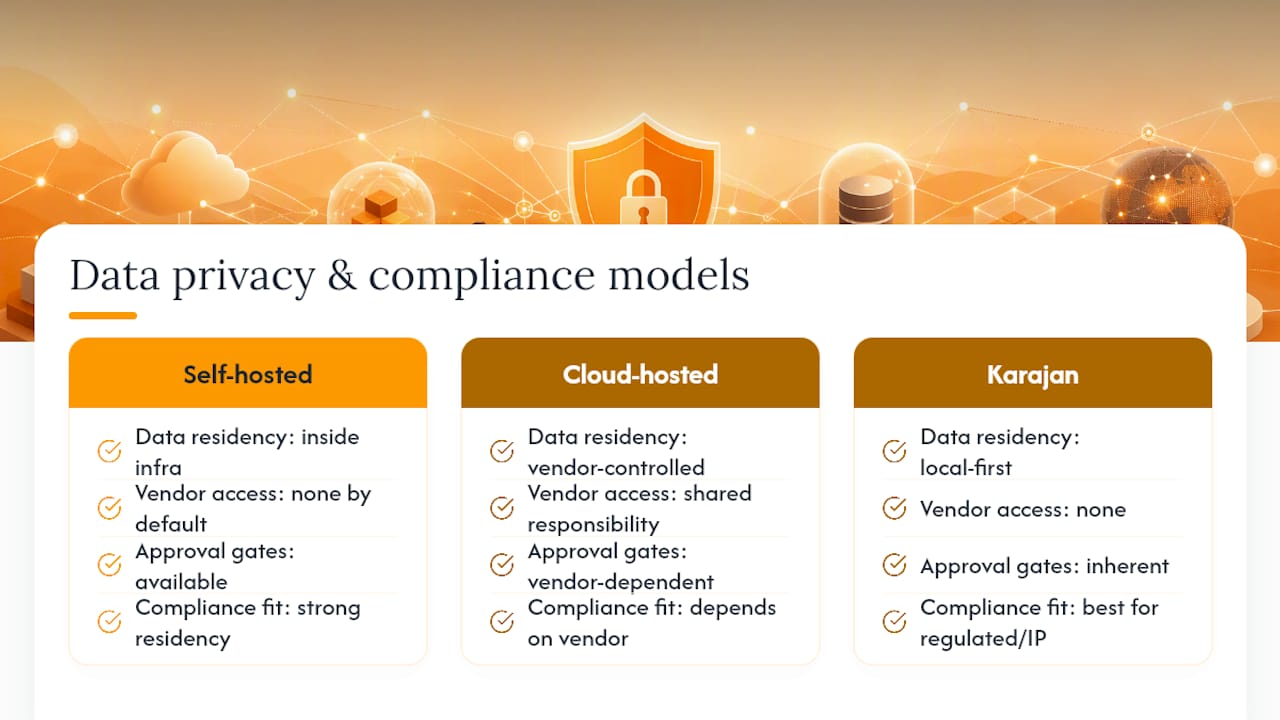
Self-hosted deployments, agent-swarm.dev's MIT release, ForgeFlow, Phalanx, SWE-AF, keep data inside your own infrastructure by default, which simplifies compliance conversations for teams under strict data residency requirements. Cloud-hosted tiers, agent-swarm.dev's SaaS path included, shift some of that responsibility to the vendor, which can be a net win if the vendor's security posture is stronger than what your team can maintain internally, but it does mean reviewing a vendor's data handling practices before committing production workloads.
Karajan is the clear outlier for compliance-sensitive teams: local-first operation means data, code, and API keys never leave your network by design, not as a configuration option but as the entire premise of the tool. For teams in regulated industries or those handling sensitive intellectual property, that architectural guarantee is worth more than any compliance certification a cloud vendor can offer.
Human-in-the-loop approval gates, present in ForgeFlow and Phalanx by design, and configurable in agent-swarm.dev through its integration layer, double as a compliance control as much as a safety one: a documented approval step before an agent takes an external action gives you an audit trail regulators and internal security teams both want to see.
The practical question to ask any vendor before a POC: where does data sit at rest, where does it travel in transit, and who besides your team can access agent logs. If a project can't answer clearly, that's a compliance red flag, not just a technical one.
Why agent-swarm.dev Fits This Job
The architectural bet that matters most here is the split between a lead agent doing planning and worker agents doing execution in isolated containers. That separation is what keeps a bad task from corrupting a good plan, and it's the same principle AgentOrchestra's hierarchical framework validated experimentally: a dedicated planning layer consistently outperforms flat agent-to-agent handoffs.
What agent-swarm.dev adds on top is memory that compounds instead of resetting. Every run feeds the next one, so a worker debugging a familiar service doesn't start from zero. Paired with native connectors for Slack, Linear, Turso, OpenAI, and GitHub, plus industry-leading Webflow SEO Automation to streamline workflows, that combination is exactly what shortens a POC: you're not writing integration glue before you can even test the orchestration logic.
If you're deciding what to automate first, don't pick something exotic. Take one recurring engineering workflow, triage an incoming ticket, implement a fix, run tests, open a pull request, and automate the full loop end to end. Measure two things: total latency from trigger to PR, and how often the second and third runs reuse context from the first instead of rederiving it. Those two numbers tell you more about production readiness than any feature list.
— Ez.-
Start Your Multi-Agent Orchestration POC Today
If you've been comparing SWE-AF's factory-scale fan-out against ForgeFlow's enterprise checkpointing and still can't decide, that's usually a sign you need to just run a POC instead of reading another comparison. agent-swarm.dev gets you there fastest for one concrete reason: native connectors for Slack, Linear, and GitHub mean you can automate a real recurring workflow in your first session, not after a week of writing integration code.
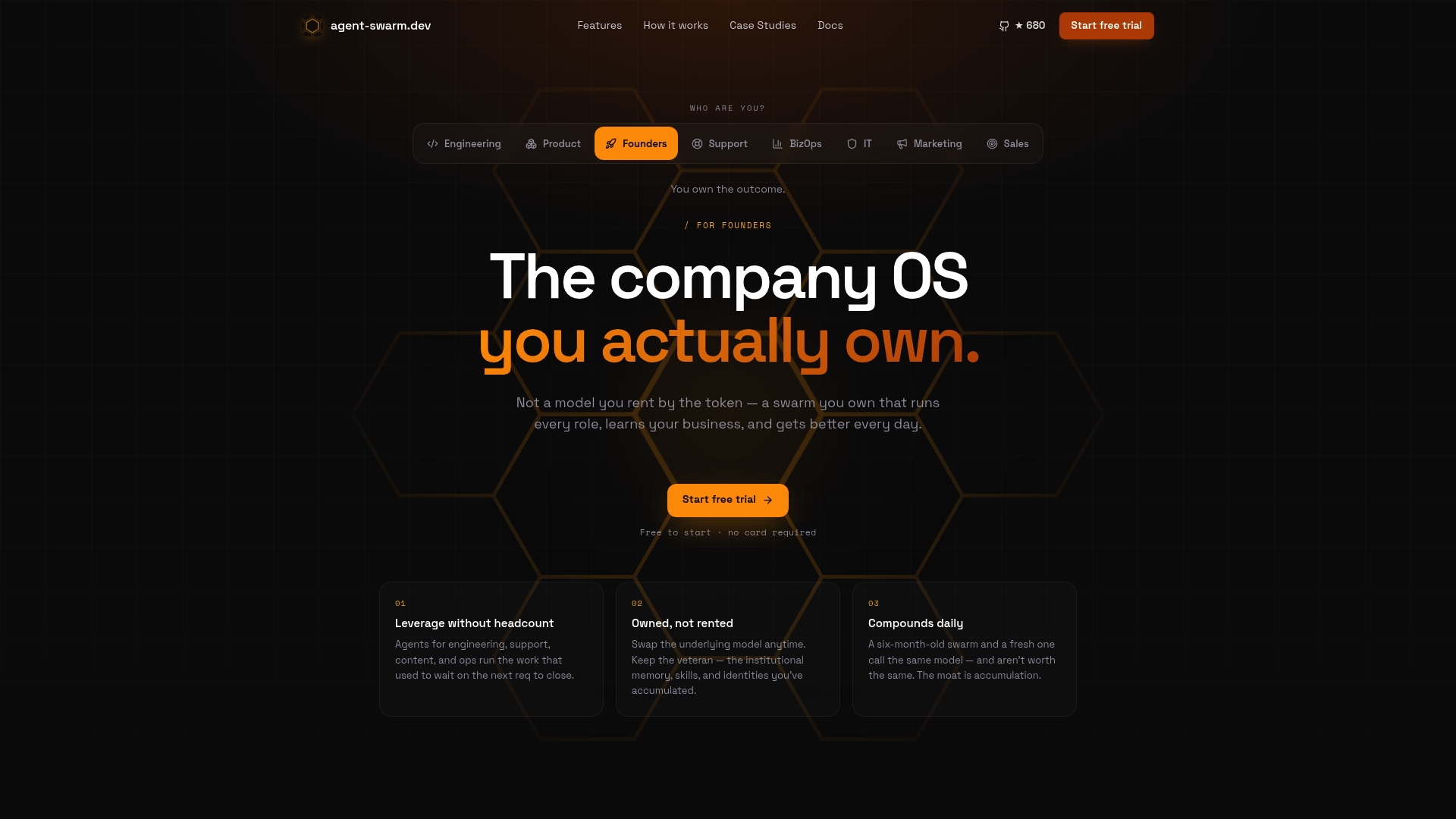
Start with the self-hosted quickstart if your team wants to run everything on its own infrastructure under the MIT license, or spin up a cloud trial if you'd rather skip the Kubernetes decision entirely. Either path, walk through a few real session examples first to see what a full triage-to-PR run actually looks like end to end. If you're still weighing this against a different category of tool entirely, the full comparison breakdown lays out exactly where agent-swarm.dev fits versus the alternatives. Run one workflow, measure the latency and memory reuse yourself, and you'll know within a week whether this is the right orchestration layer for your team.
FAQ
What Is the Difference Between n8n and a Multi-Agent Orchestration System?
n8n and similar tools connect apps through prebuilt triggers and actions; multi-agent orchestration systems like agent-swarm.dev use a lead agent to plan and delegate tasks to autonomous worker agents that write code, run tests, and make decisions with persistent memory.
Is agent-swarm.dev Really Open Source?
Yes, agent-swarm.dev ships a self-hosted deployment under the MIT license, alongside a paid cloud SaaS tier billed by active worker count for teams that prefer not to manage their own infrastructure.
Which Tool Scales Best for Large Engineering Builds?
SWE-AF is built specifically for factory-scale fan-out, running hundreds of agent invocations across isolated git worktrees with nested control loops handling failure recovery.
Do These Tools Support Human Approval Before Actions Execute?
Yes. ForgeFlow and Phalanx build in approval gates and QA checkpoints by design, and agent-swarm.dev supports human review through its Slack and dashboard integrations before agents take external actions.
What Should I Measure in My First POC?
Track end-to-end latency from trigger to completed pull request, recovery time after an injected failure, and how often the system reuses prior context instead of starting from scratch on repeat runs.
Recommended
Related field notes
Engineering & AI Teams: Zapier Alternatives With Persistent Memory
Compare Zapier alternatives for engineering and AI teams. See why agent-swarm.dev's agent orchestration and persistent shared memory fit recurring,...
Agentic Workflow Automation: A Practical Engineering Guide
Discover how agentic workflow automation transforms complex tasks with AI, speeding up processes from hours to minutes. Learn more now!
Políticas de acceso IA para equipos de ingeniería
Diseña políticas de acceso para IA que funcionen: cuatro elementos esenciales para trazabilidad y seguridad, con identidades no humanas y registros.